Pulse Flow vs Continuous Flow Portable Oxygen Concentrators
News Details
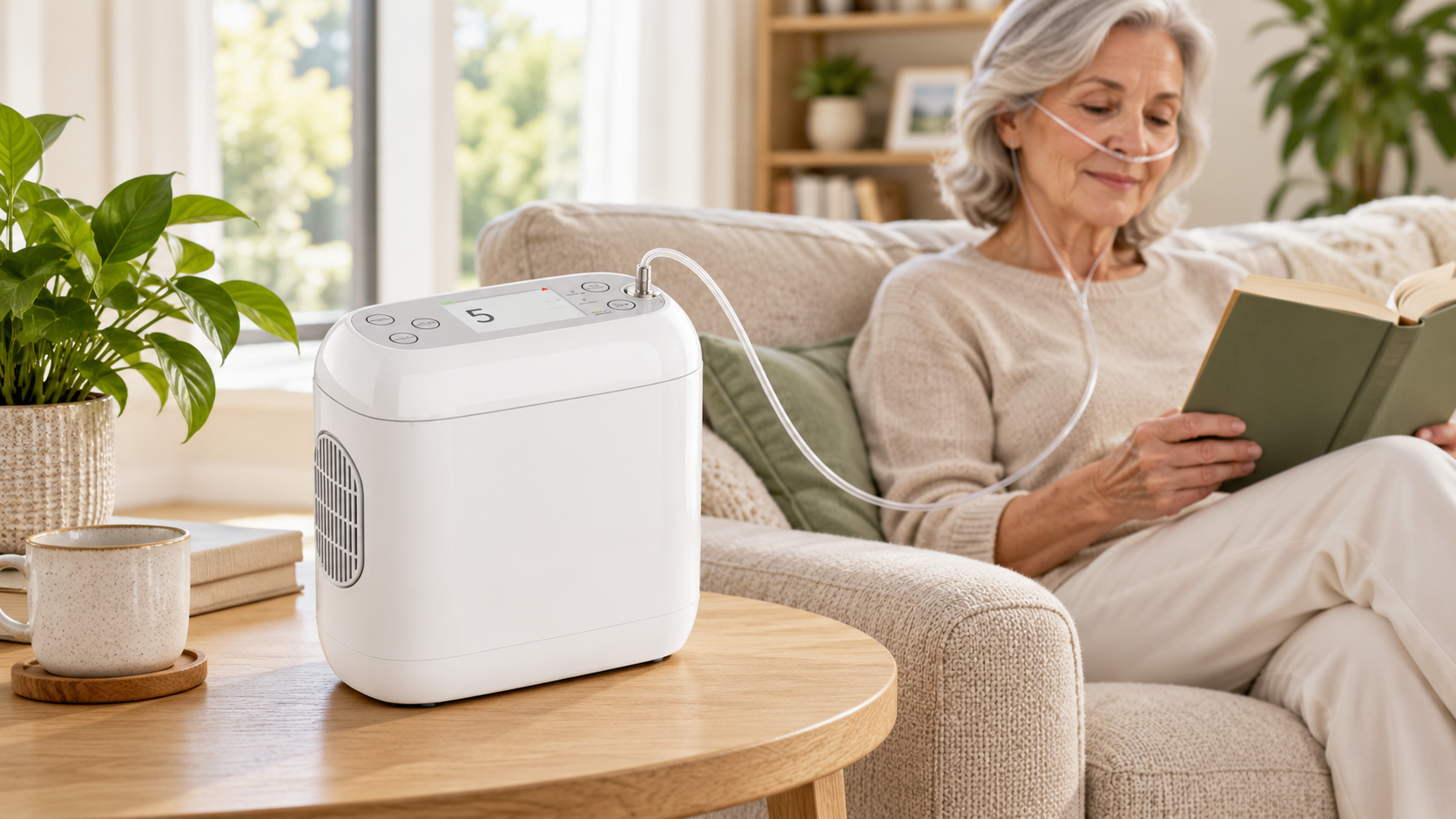
Choosing aportable oxygen concentrator involves more than comparing size and price. For homecare dealers, the flow mode affects patient suitability, product selection, and staff training. It also shapes the questions buyers should ask before placing a bulk order.
Both pulse flow and continuous flow have a role in oxygen care. However, neither is the best choice for every patient. This guide explains the differences and shows how to build a more useful product range.
How Does a Pulse Flow Oxygen Concentrator Work?
A pulse flow oxygen concentrator detects inhalation and delivers a short burst of oxygen. Instead of supplying oxygen throughout the breathing cycle, it delivers oxygen when a breath triggers the device.
This approach can support smaller designs and longer battery use. As a result, pulse flow models are often considered for patients who need oxygen while moving around.
However, the patient must be able to trigger the device reliably. A healthcare professional should assess oxygen levels with the actual unit at rest and during activity before it is selected.
How Does a Continuous Flow POC Work?
A continuous flow POC supplies a steady stream of oxygen, including between breaths. Its flow rate is measured in liters per minute, or L/min.
This mode does not depend on detecting each inhalation. It can therefore serve patients whose prescribed treatment requires continuous delivery, provided the unit meets their oxygen needs.
Continuous-capable portable models are often larger than compact pulse-only units. Battery runtime also needs close review, especially when continuous mode is used away from mains power.
Pulse Flow vs Continuous Flow POC: Key Differences
| Buying factor | Pulse flow | Continuous flow |
|---|---|---|
| Oxygen delivery | Bursts triggered by inhalation | Steady flow throughout the breathing cycle |
| Setting format | Device-specific pulse levels | Flow rate in L/min |
| Breath detection | Required for triggered delivery | Not required |
| Portability | Often smaller and easier to carry | Often larger and heavier |
| Battery planning | Check setting and breathing-rate conditions | Check runtime at the prescribed flow |
| Clinical fit | Requires assessment on the actual device | Must meet the prescribed continuous output |
Most importantly, a pulse setting of 5 does not mean 5 L/min of continuous flow. Pulse volumes and trigger sensitivity vary between models. Therefore, dealers should never use matching setting numbers as proof that two devices deliver the same therapy.
Which POC Flow Mode Is Better for Homecare Dealers?
The better choice depends on the patients and care providers your business serves.
For a customer base focused on daily mobility, compact pulse flow models may be a useful part of the range. Meanwhile, dealers serving patients with continuous-flow prescriptions need options with documented output that meets those prescriptions.
A balanced range may include both portable pulse models and suitable continuous-flow equipment. However, a portable unit should not be assumed to replace every home oxygen system.
For overnight use, follow the device instructions and the clinician’s recommendation. Sleep suitability cannot be decided from the flow-mode label alone.
What Should Dealers Ask a Portable Oxygen Concentrator Supplier?
Before choosing a portable oxygen concentrator supplier, request clear answers to these questions:
-
Output: What pulse volume or continuous flow does each setting provide?
-
Oxygen concentration: What concentration is maintained across the rated settings?
-
Battery performance: What runtime is measured at each mode, setting, and test condition?
-
Daily use: What is the total carrying weight with the battery installed?
-
Service: Are batteries, filters, spare parts, and repair support available?
-
Documentation: Which model-specific documents support sale in your target market?
Next, compare total ownership costs. Include replacement batteries, staff training, maintenance, and warranty handling alongside the purchase price.
Finally, request a sample and review its controls, alarms, charging process, and manual before committing to a larger order.
Explore Provision Healthcare’s Portable Oxygen Concentrators
Provision Healthcare lists several portable models for dealer review. For example, the KP-6S product page specifies pulse flow, a listed weight of 1.6 kg, and oxygen concentration of 93% ±3%. It also lists OEM/ODM options and a minimum order of 50 pieces for customization.
The KPE-8 lists pulse flow plus fixed-frequency delivery and a weight of 2.2 kg. Fixed-frequency pulses should not be confused with a steady continuous flow. Buyers should also distinguish advertised “equivalent flow” figures from verified continuous output in L/min.
To discuss your product range, contact Provision Healthcare with your target market, required delivery modes, and expected order volume. Request current technical sheets and sample options to compare models against your customers’ needs.


